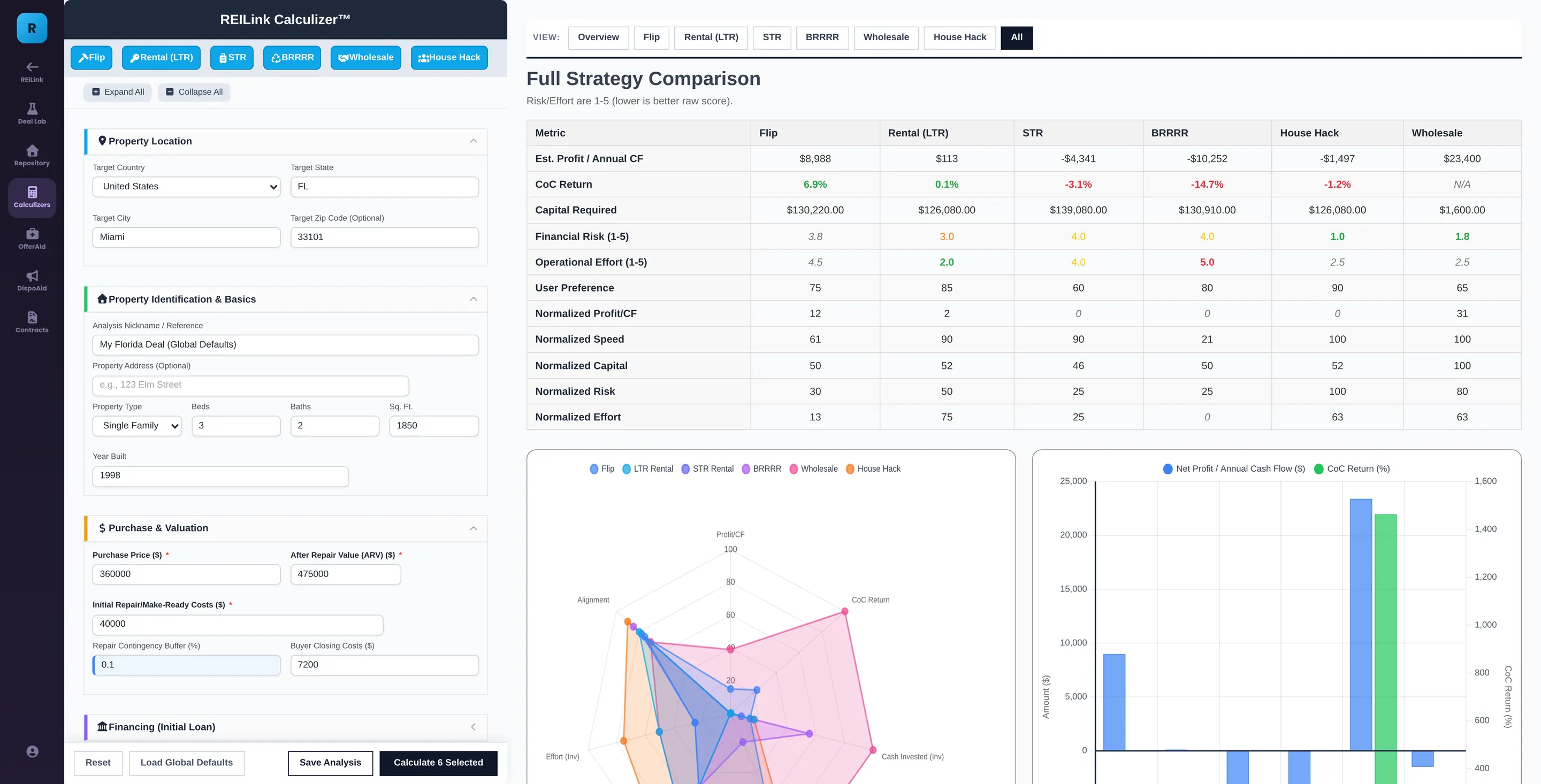
Enter the property once. Calculizer runs a complete real estate investment analysis for flip, long-term rental, short-term rental, BRRRR, wholesale and house hack at the same time and puts the results side by side. Then every major figure opens to the equation that produced it, using your actual numbers.
Free. Not a trial and not a limited tier — the calculator itself
never costs anything.
Already have a REILink account?
Open the Calculizer.
Instead of using a separate investment property calculator for every strategy, enter the property once and let Calculizer run the major investment analyses together. The purchase price, repairs, after-repair value, financing, rents, taxes and the rest of the property assumptions go in a single time. Calculizer runs six complete investment analyses at once and compares the profit, the return, the capital required, the risk and the effort of each strategy in one place.
You are not choosing an exit strategy first and then trying to make the numbers support it. Instead of forcing one property through one predetermined strategy, Calculizer works as a real estate deal calculator: run the property, compare the exits, and let the numbers show which structure actually makes sense.
Four moments from one session on one property — a $360,000 purchase against a $475,000 after-repair value, with $40,000 of work. Step through them.
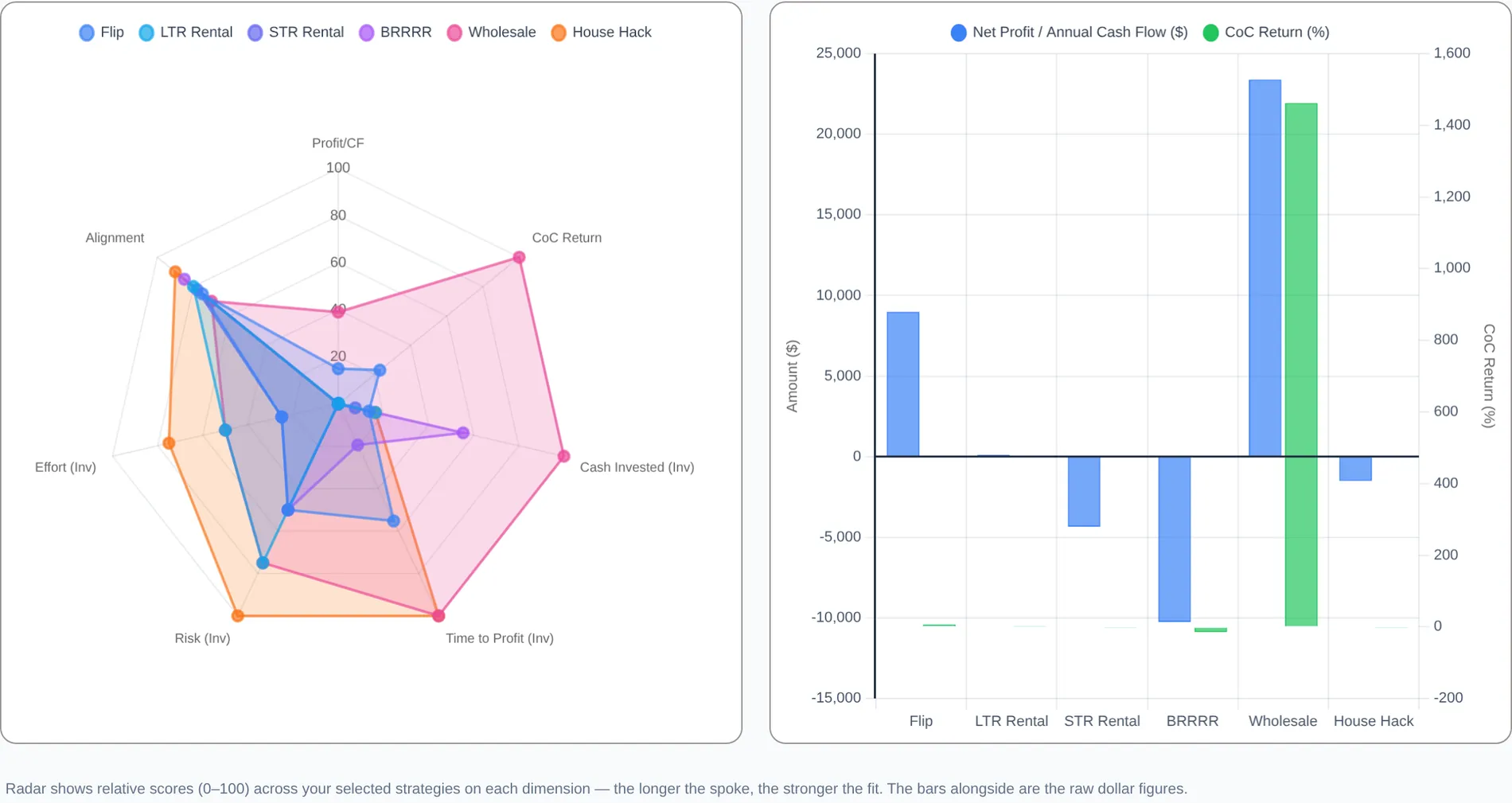
Six exits, off one set of inputs. Flip, rental, short-term, BRRRR, wholesale and house hack, ranked in one grid — with the ones that lose money shown losing money. The comparison, at the top of the results
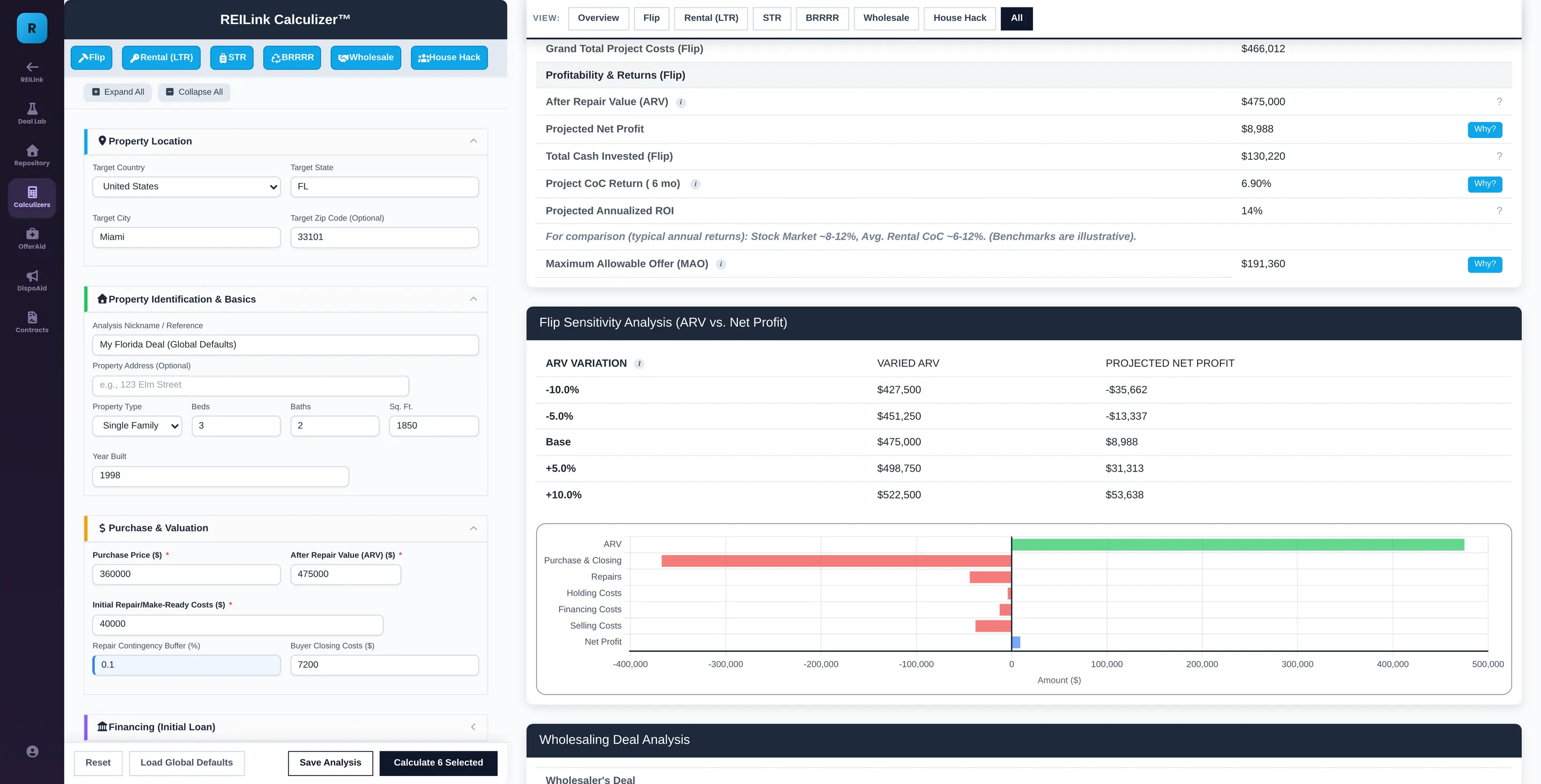
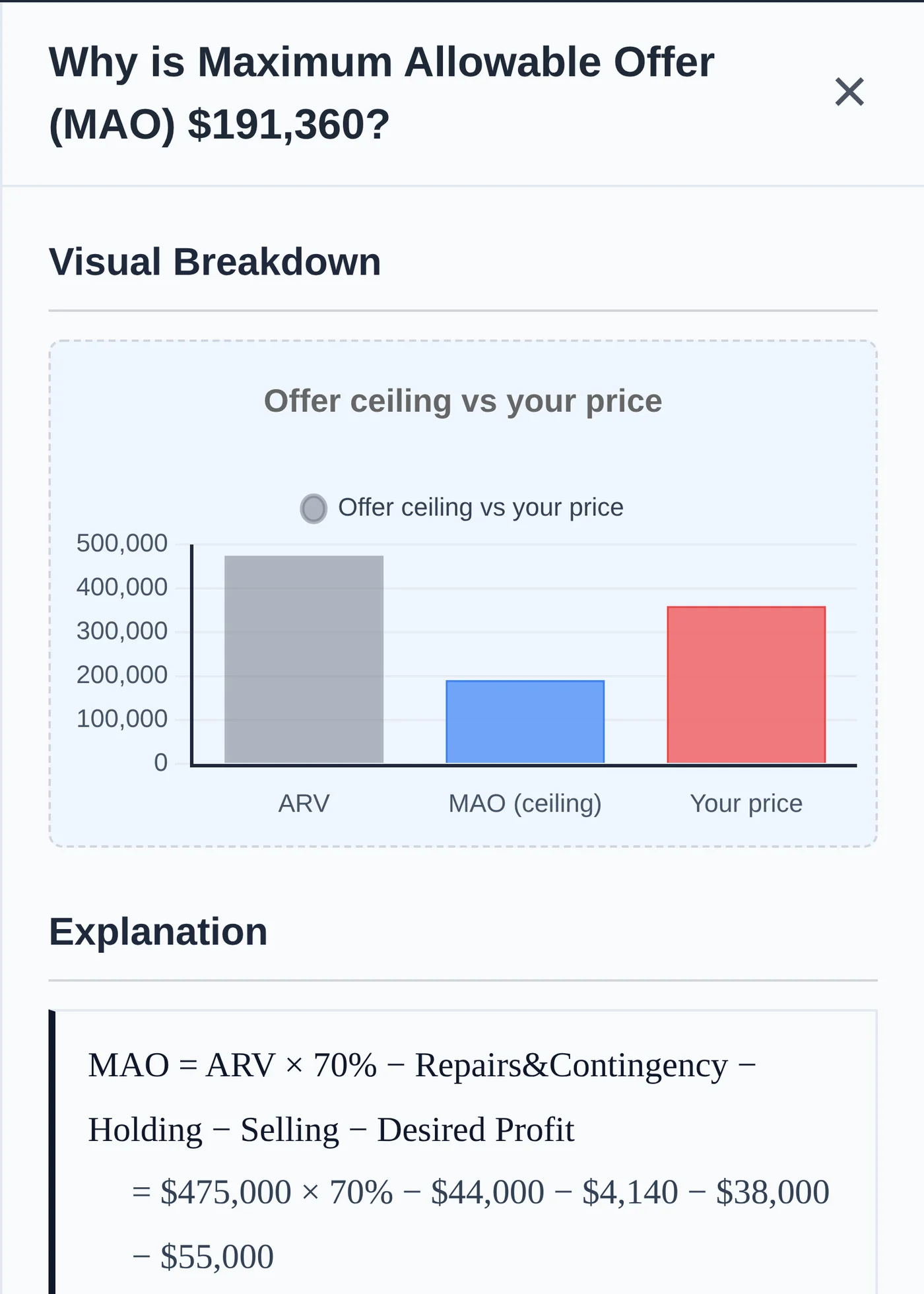
Press Why beside the maximum allowable offer. $191,360 — and the panel opens with the formula, your own numbers written into it, and the result. It recomputes at the moment you press, so it cannot disagree with the row. Flip table · the Why button on the MAO row
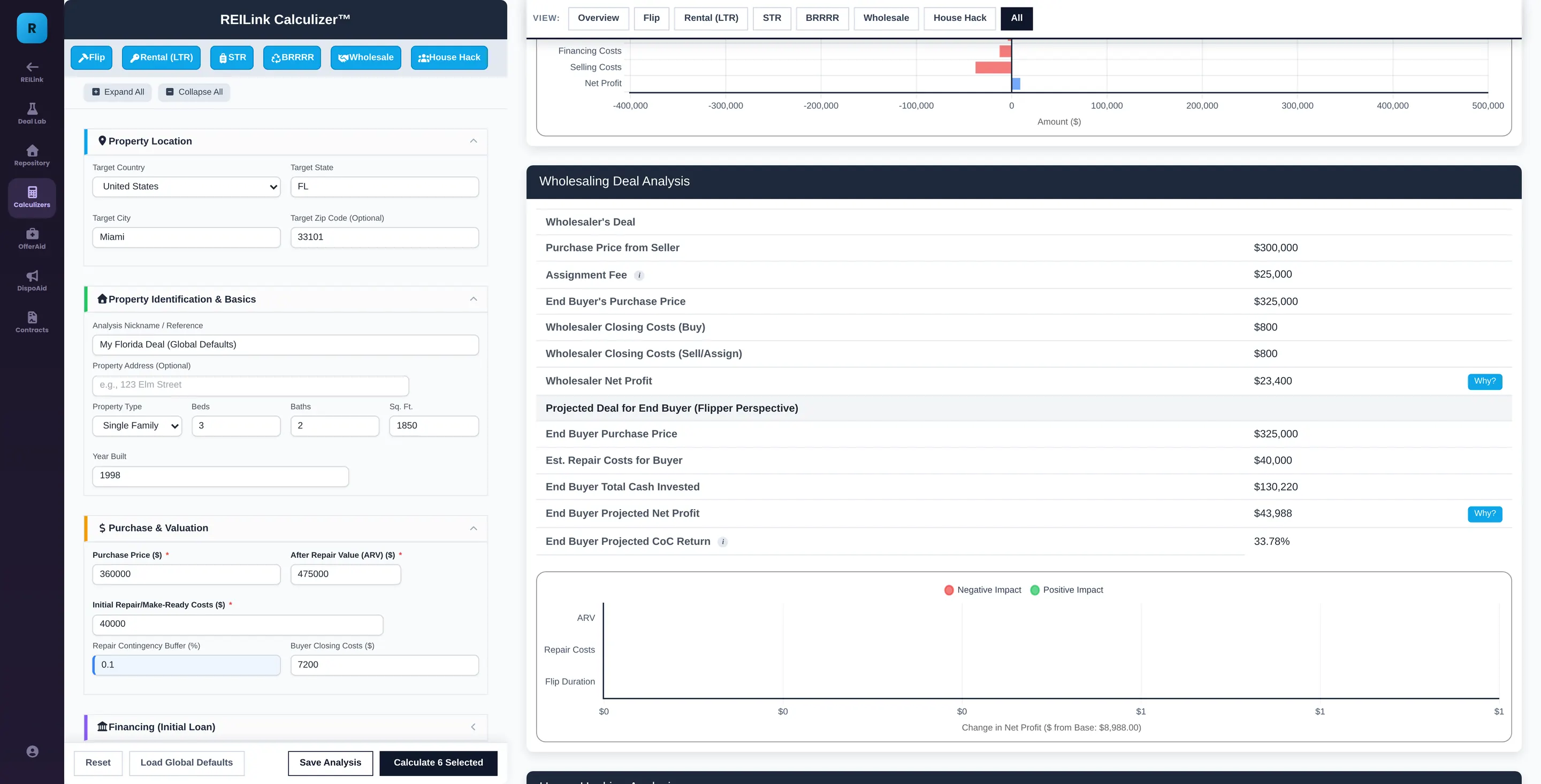
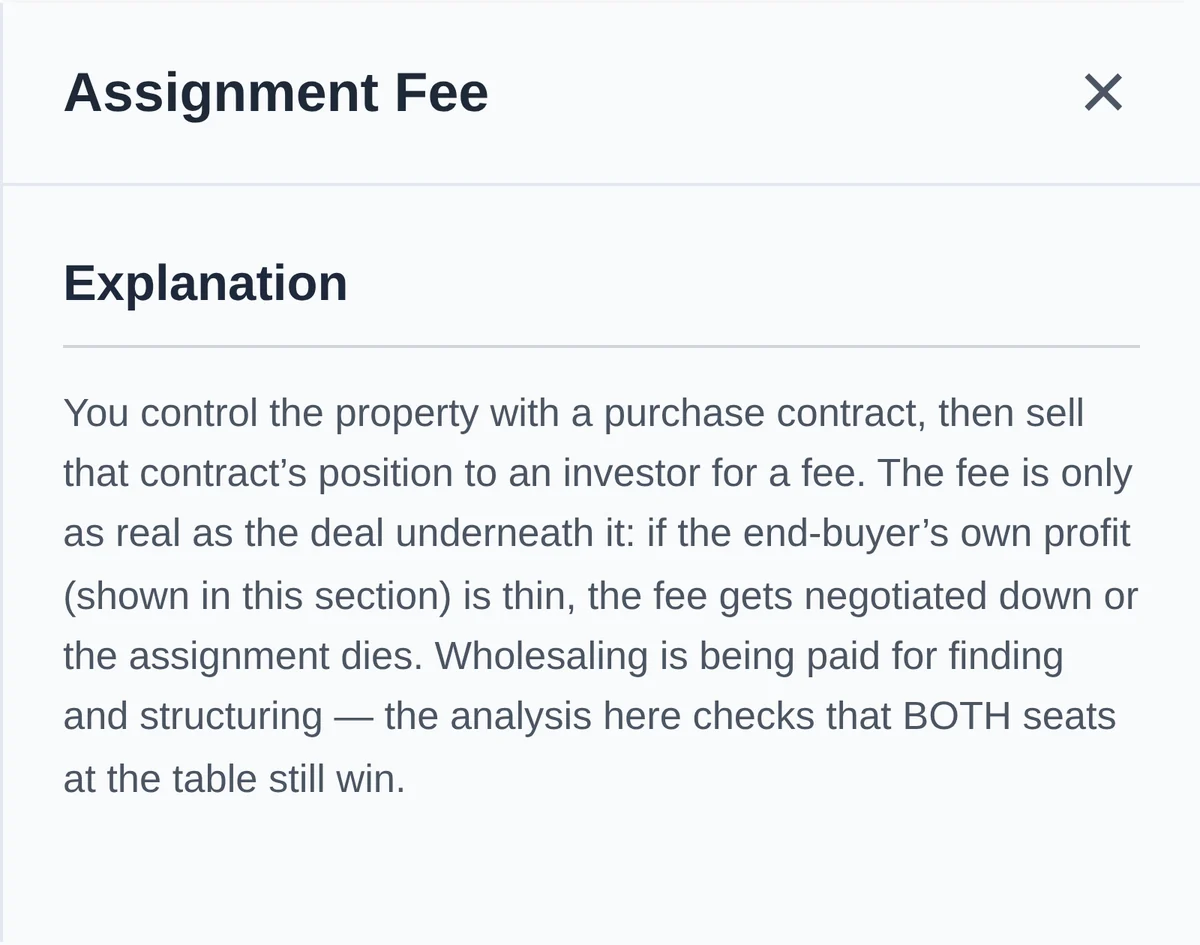
Press the marker beside Assignment Fee. The definition opens where you met the term — what it means, and the trap in it. Definitions never spend a credit; they are exempt in the code itself. Wholesale table · the glossary marker
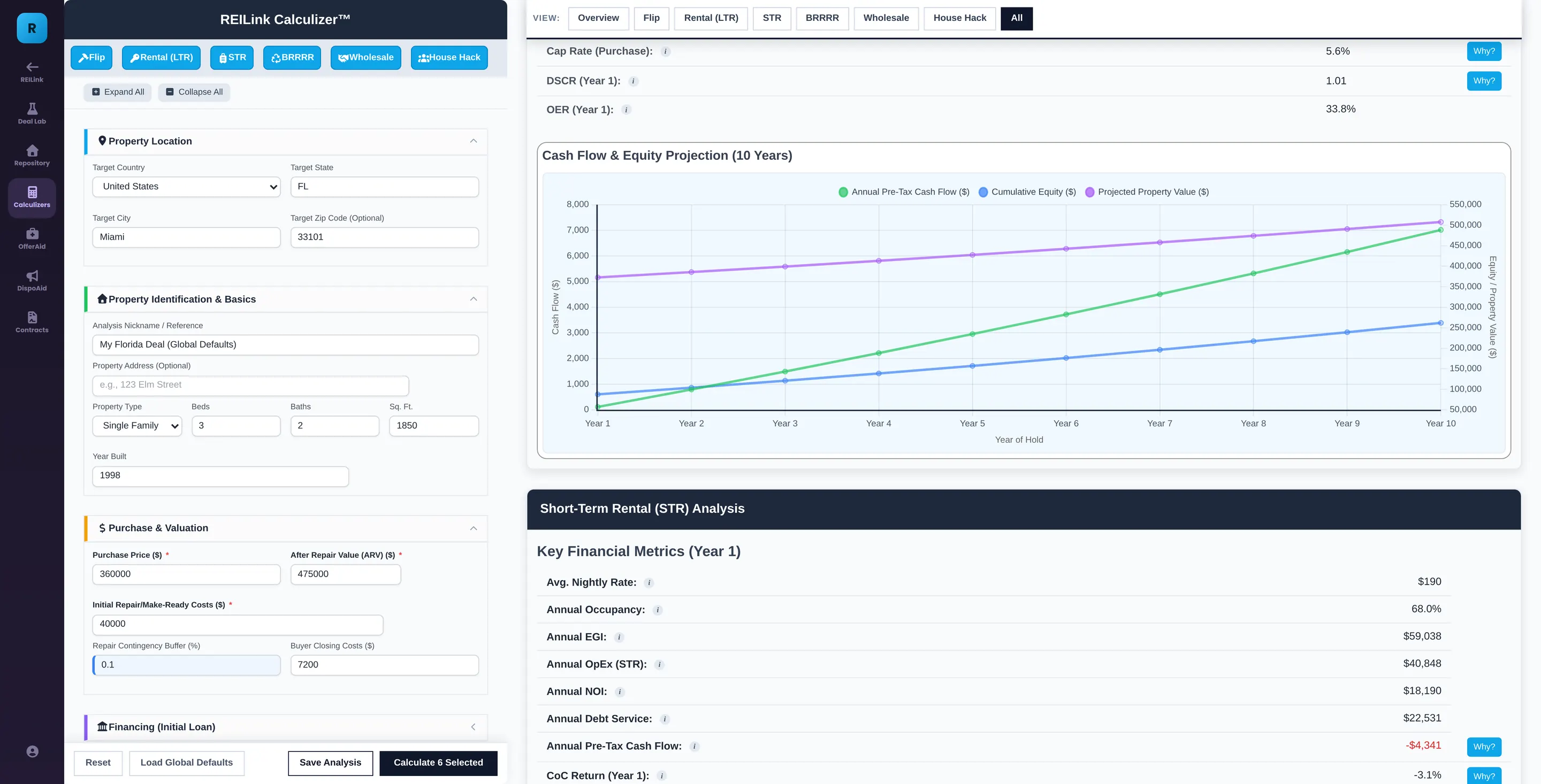
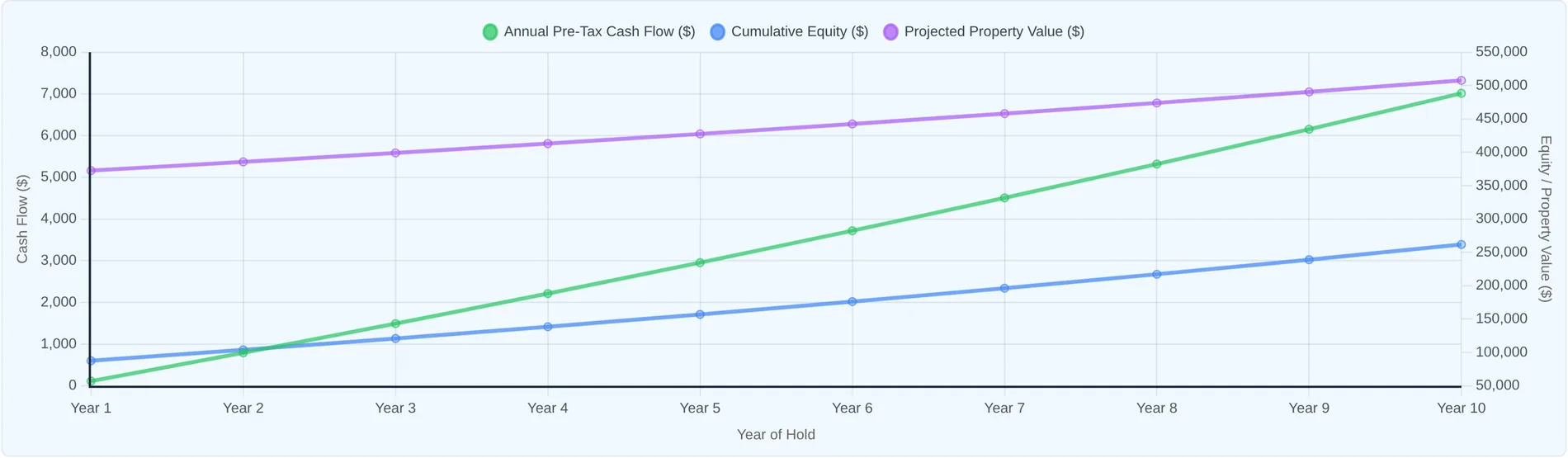
And the hold runs ten years, not one. Cash flow, equity and property value across the whole period, at your own growth rates, with the sale at the end priced however you think is honest. Rental section · the projection itself
Most calculators give you a result and stop there. Calculizer lets you open the result and see the formula, the inputs from this property and the calculation that produced it. The panel recalculates from the current deal when you open it, so the explanation and the result stay tied to the same numbers.
And then, underneath, in words: this is your walk-away ceiling. The price on the table was $360,000 — $168,640 above it. For that price to sit inside the rule, the after-repair value would have to reach $715,914 — and the panel tells you to believe that only if the comparable sales prove it.
Calculizer doesn’t try to make every property look like a deal. If a strategy loses money, the loss stays visible. If the cash flow is weak, you see it. If another strategy performs better, you see that too.
The point isn’t to confirm the strategy you already wanted to use. It’s to find out what the numbers actually support before you buy the property.
Three strategies lose money on this property. Calculizer shows the losses instead of hiding them.
Year-one cash flow doesn’t tell you what happens over the life of the investment. Calculizer projects the property year by year for up to 10 years, including rent growth, expense growth, loan amortization, cash flow, property value, equity and the eventual sale. You can calculate the exit value from appreciation or an exit capitalization rate, then see both pre-tax and after-tax results, including depreciation, recapture and internal rate of return.
Most real estate investment calculators answer one question at a time. A flip calculator tells you whether the property works as a flip. A rental property calculator tells you whether it works as a rental. A BRRRR calculator evaluates a BRRRR. Calculizer runs those decisions together — enter the property once and compare the major investment strategies without rebuilding the deal six different times. That makes it both a property investment calculator and a strategy comparison tool: the property stays the same while the exit changes.
Purchase price, rehab costs, contingency, financing and origination points, holding costs, selling costs, after-repair value, projected net profit and the most you can pay.
Rent, operating expenses, net operating income, cash flow, capitalization rate, cash-on-cash return, debt service coverage and ten years of equity and value.
Nightly rate, occupancy, cleaning and platform fees, restocking, lodging tax, a furnishing reserve, and the return once all of it is paid.
Cash in for the buy and rehab, refinance at your loan-to-value, cash out, cash left in the deal, and how the property performs once it is stabilized.
Purchase price from the seller, your assignment fee, closing costs on both sides — and the end buyer’s own profit and return, so you can see whether the fee survives their analysis.
Rent from the tenant units against the whole property’s costs: your net monthly living cost, and what you save against renting your own unit.
All six investment calculations, formulas, definitions and projections are free and do not use Humphrey credits. Credits are only used when you ask Humphrey to interpret the deal for you. Each AI feature has its own on/off switch, and a master switch can pause all three. A feature that is switched off never calls the AI, so it cannot spend a credit.
Reads all six strategies together and gives you a verdict: whether this is a deal, which single strategy fits best and the figures that make it the winner, and the biggest risk to watch. Three paragraphs, specific to your numbers.
Sits at the bottom of a Why panel, underneath the calculator’s own working and never in place of it. Names the one thing in your figures driving that result, and the single most effective lever to change it.
The calculator flags weaknesses on its own, by rule. Consolidate rewrites that list into the five to seven that matter most for this deal, merged, ranked by impact and written in your numbers. The original list is kept and restored on any failure.
Every Humphrey card carries the same footer: what it uses, the switch to stop it, and where to manage or buy credits. Nothing is hidden behind a menu.
Flip, long-term rental, short-term rental, BRRRR, wholesale and house hack.
Including the spider across all six and the ten-year projections.
Formula, your numbers, result, the levers that move it, and a chart.
Hover and full-panel both, on every financial term in the results.
Filtered by strategy, off the calculator’s own rules.
The whole projection engine.
Kept against the property and reopened whenever you want it.
Humphrey’s read on whether to do this deal at all.
The driver and the lever, on top of the calculator’s own working.
The same warnings, prioritized and rewritten in your figures.
Turn Humphrey off and the page is identical apart from three missing paragraphs. Nothing recalculates, nothing is withheld, nothing greys out. That is not a promise about our intentions — it is how the code is built: the AI is a layer on top, and when it is off or unreachable it removes itself and leaves the calculator untouched. Every screen in the tour above was captured with it switched off.
A real estate investment calculator uses the purchase price, financing, income, expenses, repairs, projected property value and other assumptions to estimate how an investment property may perform financially. Calculizer goes further by running multiple investment strategies against the same property instead of requiring a separate calculation for each one.
Six: fix and flip, long-term rental, short-term rental, BRRRR, wholesale and house hack. All six run from the same set of inputs and are compared side by side.
Yes. Calculizer includes a full long-term rental analysis — income, operating expenses, net operating income, debt service, cash flow and a ten-year projection. It also lets you compare that rental result against five other ways of structuring the same property.
Yes. BRRRR is one of the six strategies. You can compare the BRRRR outcome against flipping, renting, wholesaling, short-term rental and house hacking without re-entering the property.
Yes. It analyzes the property as a flip — including the maximum allowable offer — while also showing whether another strategy would produce a better result on the same numbers.
Across the six strategies it reports:
Yes. The calculator itself is free. Running the six investment analyses does not require credits, and neither do the equation panels or the definitions. Credits are only ever spent on Humphrey’s written opinion, which has its own switch and can be left off.
Run the property as a flip, rental, short-term rental, BRRRR, wholesale deal and house hack from the same set of inputs.
The calculator is free and stays free. Credits are only ever for Humphrey’s opinion, and you can leave him switched off.